
Back in 2020, I did my first blog post on AI, commenting that while many saw its emergence as a threat, I didn’t. With the choices available to them, people like me could elect how much if any machine-learned automation might become part of our lives.

It’s five years later and I thought I would revisit that idea again, again from the perspective of a senior retiree. I do recognize that other lifestyles and financial circumstances might result in a different viewpoint, but this is mine.
Here’s how AI has impacted me in the last five years and how it might impact me in the future.
Let’s start with an obvious one – impact on my activities as a hobbyist photographer and videographer. Personally, this has been nothing but positive. As I highlighted in the previous piece, new software was emerging to remove the drudgery and repetitiveness from many digital tasks and this has continued non-stop for the past five years.
But, key to this perspective, is that I am able to pick and choose where the boundary lines lie for me and where the separation between drudgery and creativity lies for me. Thankfully, the designers of these products have recognized that one size does not fit all. I now have tools that will do as much or as little as I want them to do. The AI-driven tools often come with assistants, sliders and buttons that dial in exactly what level of comfort I want.
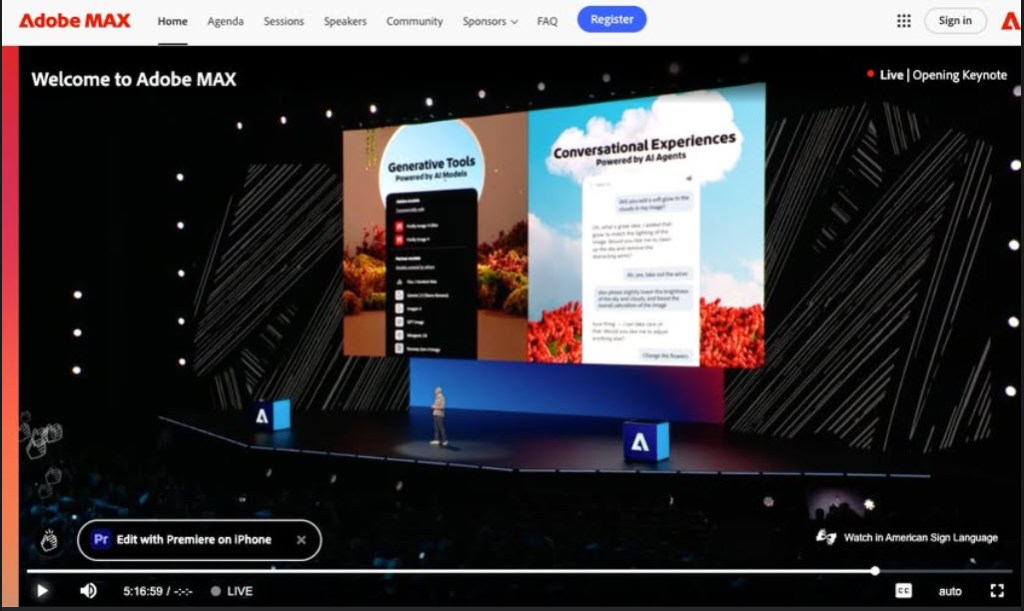
I recently attended (virtually) the annual Adobe Max event, where the latest updates to the Adobe ecosystem were revealed. By far this year’s event was focused on designers and compositors, with barely a mention of photographers and few sessions dedicated to them. For designers, the AI-driven tools have astounding capability to create something from nothing, if desired, or to augment your own creation with as many embellishments and special effects as you can conceive of. They called it “hallucination”. A wholly appropriate label. The keynotes talked about AI-driven tools and creator/software conversational experiences, where the intelligence becomes a companion to your creativity.
Absolutely great for those that want this. I don’t. I just need it to remove dust spots from my images with one click. I got that too. A whole collection of efficiency improvements, even AI-assisted culling, and gentle embellishments that help me overcome some creative and age-based limitations (worsening eyesight, shaky hands) in my own persona. I can have it all too if I want – with my “all” defined very differently. I absolutely love the improvements they have made to all the tools I use.


And AI-driven tools have allowed me to discover and do a deep dive into astrophotography, by automating many of the frustrating elements of the hobby that limited it to nerds, geeks and tinkerers for decades. Things like finding your targets in the sky, focusing on those targets and dealing with the rotation of the Earth. You can consider that to be good or bad, but I think it’s amazing.
Next, let’s talk about managing a senior life. This year, I’ve done some major home renovations, planned a bunch of trips and looked into a variety of services to help me around the house. I also had several medical tests and was able to access all of the results in apps on my phone. And I have lots of home automation devices in my house, to help with mundane tasks such as turning on lights and managing security.

In all cases, AI played a role in these efforts. I searched for home and trip management information through AI-driven search engines that let me be as specific as I desired about what I was looking for. I was able to ask questions and get answers. I reviewed all my test results in detail supported by AI-driven apps that helped me interpret the results much more comprehensively than the conversations I am allowed to have with my doctor. In fact, they even suggested questions I should ask my doctor and helped me make those short appointment times much more efficient. And, a minor thing, but I no longer have to use my arthritic hands to turn on and off the lights – I can just ask my devices to set a schedule. In fact, I schedule many things through my AI-driven apps. I love it. They can even choose music to play for me depending on my mood.
I said I wouldn’t talk about other lives or experiences and how AI might impact them. But I do want to raise three considerations that all of us might be subject to and that are really the heart of the negative opinions on AI. AI has gotten a bad rap in some circles, even to the point of being a dire threat to our human society. I don’t know where it will go in the next 20 years (I probably won’t care after that) but here’s what I see now.
The emergence of AI does raise a valid concern of how we tell real from fake. More and more items are appearing in our online feeds, contacts and interactions each day claiming to show a real event, person or thing. More and more of these are turning out to be exactly the opposite. Some of these are funny – some are damned scary. And many target innocent people, especially seniors, to extort money from them. The number of warnings I’ve received over the past year of fraudulent scams is really frightening. That is a real concern about tools and technology that can fool us so well.
But really, that isn’t new. Frauds and scams have been in play all my life, well before computers were part of daily life. I embarrassingly admit to falling prey to one when I was in my twenties, and lost $500.00, which was a huge amount of money at the time. It hasn’t happened again. I think we hear more about them now because they can affect whole communities of people at once and be executed from the other side of the world. Strangely, I’m not really worried about these for myself personally. Once bitten, twice shy – I don’t trust until I can verify.
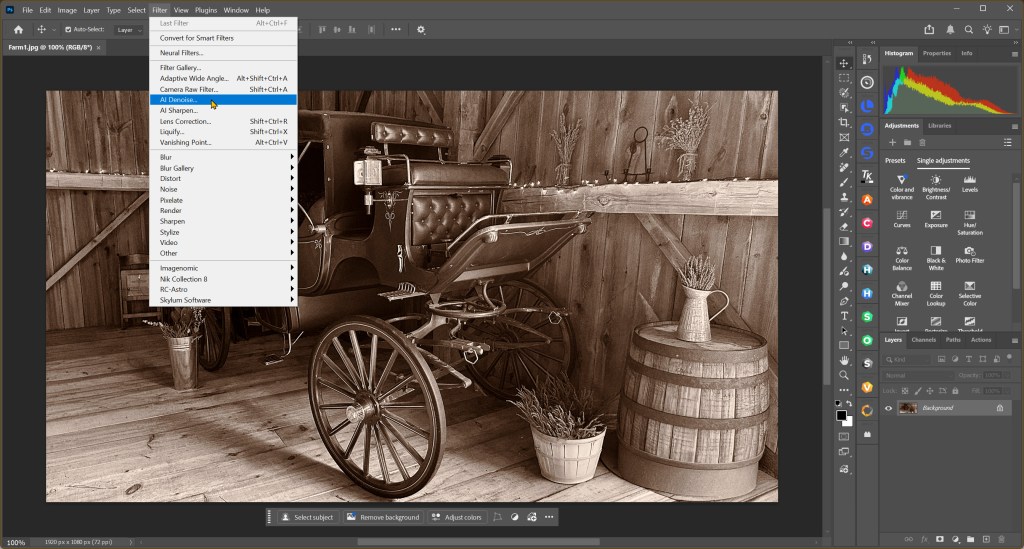
A more interesting issue for me is defining “real” in the context of digital photography. The application of these sophisticated AI-driven tools opens the door to criticism that an image is no longer “real”. I’ve listened to all the viewpoints. I’ve landed where I feel comfortable – I have definite limits on how much I will “hallucinate” in a photograph and I call that “real” for me. I honestly don’t care if anyone else agrees. I’m not offering my images as photojournalism. I’m not trying to sell you an experience I did not have. I just hope you enjoy my pretty pictures.

The emergence of AI also raises a valid concern of recognition of effort. In some circles, the effort put into an activity is as important as the result. That seems to be most true in professions that require a lot of time to become recognized, credentialed or to achieve competence. Visual and graphic arts are the usual example here, where people used to spend years and thousands of dollars to become brand qualified, but these concerns could equally apply to financial and science-based professions.
We often reward effort through prizes and publicity. Definitely true in photography, where contests now stipulate that AI cannot be used to generate any part of an image. The creator has to document the effort/tell the story of capturing that image. Unfortunately the dividing line between can and can’t is becoming blurry – is dust spot removal with an AI-trained tool acceptable or not? Is colour correction through an AI-trained tool acceptable or not? Reputations are almost always defined by effort, so managing this fairly will be a challenge in the future.

And lastly, the emergence of AI does have financial impacts on some professions, both positive and negative. I’m actually less concerned with this though, as this has been the case throughout human evolution as an industrial society. Trades and professions and products and services come and go with our evolution as a species. Witness horse-drawn carriages and buggy-whips. The big ones in my generation were the arrival of the desktop computer and the advent of the Internet. These changed work as we know it. Similarly, witness the debate now over the future of the Post Office in Canada.
And generally, the average person does not like change. I spent a portion of my working career helping average people cope with it. It will not be going away. But I do appreciate that there is and will be pain as people transition careers. And I do worry about my younger family members and whether they will successfully find their way. I am lucky not to have to worry about this again. But I also hear there are so many professions and trades crying out for experts now that part of me feels optimistic. I am a little bit sad though that I won’t be around for another turn of the century to see how it all goes.
So the bottom line for me is a simple one: I can’t control the evolution of AI. I can’t control the good or the bad things that are done with it. As a matter of fact, I got a scam call as I was writing this. But I can control how it affects me. And so far, it’s been a lot of fun.
Postscript: After posting this, I ran across some interesting statistics on the impact AI is having on current job postings for one of the largest job sites – Indeed. It’s quite interesting.
An analysis of 180 million job postings shows AI is hitting creative execution roles hard while leaving strategic jobs mostly untouched. The analysis of changes in Indeed listings from 2024 to 2025 found computer graphic artists postings drop 33%, photographers 28%, and writers 28%, while overall job postings fell just 8%. But creative directors and designers? They’re holding steady. The real winner is machine learning engineers, with postings up 40% – the biggest jump of any role. Senior leadership jobs barely declined (down 1.7%), while individual contributor roles dropped 9%. Software engineering remains surprisingly resilient despite all the AI coding tools, and customer service rep jobs fell just 4%, proving AI chatbots aren’t replacing humans as fast as predicted.
 oldgirlphotography.ca