
I’ve had the opportunity over the past few months to visit several galleries where photography exhibitions had opened. These openings were in no way related to each other: one showed historical/documentary work, one showed the natural world and one showed artistic creations supported by artificial intelligence. In two cases, the artist or curator was available to discuss the work as I wandered through it. Each was a wonderful journey. Let me telll you why.
This isn’t a critique of work. In fact, the artists themselves are not mentioned here, but links to the exhibitions are provided for your interest. I wanted to highlight some of the common elements of the experiences that make a gallery visit so worthwhile.
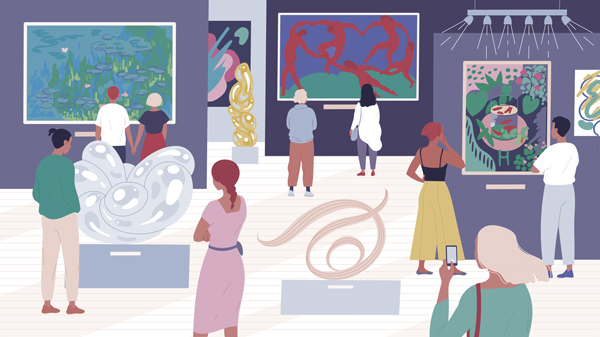
Every gallery aims to create a mood to support its artists. Some have alcoves and hallways, lit differently to showcase one or two premium items separately from the rest. All of these layouts support the physical journey of the viewer through the exhibition, walking supposedly on the same journey as the artist. The layout intrigues you even before you see the first piece. It’s surprising how this can add to the experience, but it does.
When you arrive at the gallery, there is often a large banner about the exhibition. And just inside, some biographical information about the artist. You get to know them right out of the gate. There are often really cool elements to their personal stories, such as starting out in traditional perhaps more mundane non-artistic work and either discovering their true passions or their use of art as an outlet. I find it fascinating how so many artists combine technical careers with artistic expression. It’s always given me confirmation of what is possible for me.

The arrangement of the work is always interesting to me too. Sometimes it’s easy, showing a timeline from early work to later work, with life experience narratives along the way, or separate sections that show the evolution of their work in different periods. But it’s when it’s not chronological that I pay more attention.
Sometimes the display is purely geometric – putting pieces side by side that in a simple layout create art themselves. Large pieces surrounded by smaller ones. Primary coloured frames surrounded by complementary colour frames. Squares balanced by rectangles. Horizontal alignment offset by the occasional vertical item that intrudes on the straight line. I’m told that irrespective of the art itself, the display layout can have a powerful impact on the perception of the work. I would agree.
Even the spacing of individual items contributes to the message. In our world of phone screen flips with one finger, we can browse an entire gallery of images in a minute. A physical visit to a gallery forces you to walk through, albeit at your own speed, but still forces you to slow down. That more than anything to me is the key to making a gallery visit successful – taking the time to take it all in. I initially used to wonder why there was so much empty wall space in some gallery displays (and I still think some take it too far), but now I understand just how much the layout contributes to the final experience. It truly is a skill.

Other than chronologically, gallery presentations can use a variety of themes to sequence the work of its artists. Sometimes it’s colour, sometimes it’s subject matter, sometimes even mood. I do find I get more out of the experience if I can see some relationship between the pieces – at least the pieces that are within my field of view at any one time. Humans like patterns and sequences – we naturally find them appealing. It’s almost like subliminal messaging. So a layout that recognizes this is a win out of the gate.
All three of the referenced exhibitions did this very well. I found myself doing exactly what was expected – wandering slowly through the exhibition, stopping at each piece to absorb it and its story, frankly noticing so many more things than I would have noticed with my finger swipe on my phone.
But what really made the full experience meaningful for me was the opportunity to talk to the artist or the curator of the exhibition. Sometimes the artist will give a brief talk on opening night. But I really want the backstory. This is difficult to get on opening night, so sometimes I will return for a second visit or skip opening night altogether if I know the artist will be onsite at a future date. I’m like a little kid – I ask a lot of questions about anything that fascinates me. Too much, sometimes. But I do find that as long as I’m not preventing others from connecting, the artist doesn’t mind the attention.
Exploring the creative process through the artist’s mind is almost as fascinating to me as the work itself. I continue to look for ways to inspire my own creativity, and asking others “what were you thinking?” is a great way to do that. Sometimes the answer is simply “I saw an opportunity and I took it.”, but generally I find that artists who successfully deliver gallery shows have their creative ideas/concepts in their minds well ahead of anything produced in print. While the actual item may be the result of hours of unplanned creative effort, the initial concept is always something that was in their mind from the beginning. That truly is fascinating.

It must be an incredible challenge to curate a show, whether your own or someone else’s. You typically don’t mount a show until you have a significant body of work. How then do you possibly decide what gets put on display and what does not? It must be agonizing. I’ve given talks on my work using slides, and go through mind-numbing repetitions trying to decide what to include. In the end, though, I do find a plan usually unveils itself. That seems to be true here as well, from what I’ve gleaned.
There is something to be said as well about wandering through the gallery and listening to other visitor reactions. Not that I eavesdrop, but sometimes you overhear a comment that makes you stop and think. Even contradictory opinions, of which there can be many for any form of art, are intriguing to consider. Going through the experience with other people can truly open your mind.
If there is a specific genre of photography that interests you, I would highly recommend seeking out gallery shows that bring this work to you in print. There is a long standing debate about the role of print works today, but I can definitely attest to the inspiration drawn from wandering a physical space and looking at physical product. In these cold dark days of winter, it is a feast for the soul.
 oldgirlphotography.ca
I am so glad you got a chance to take in Jack’s show in your triple play of the month. Sometimes I wonder what is going on in that head, and seeing it in print was great for even myself.
LikeLike
I wish I had that imagination. All three shows gave me some great inspiration but now it’s all about acting on it…
LikeLike